Scripture for Our Time
A Chapel Talk
William Stafford
at Lewis & Clark College
1 Mar 1962
Sometimes listening alertly to Scripture, I am touched with a flickering realization of how it might be to live in times when Scripture is lived and write. Think of coming alive to participate in human events so important that they connect with the everlasting. How would it be to know that what you did, what you said, what you wrote, how you responded to others was crucial?
I love this sly guy William Stafford, copied this exerpt from the typescript of the chapel talk when I was at the library at Lewis & Clark College this last Sunday. Here's some more:
...and I think steadily about our own times: there should be writings so coercive that all in our time yield to them. Maybe our crisis is an art crisis: people must come to believe art, and art must come to be worthy of belief.
Yes! Yes! And keep talking, Mr. Stafford:
...An ultimately responsible writer could feel this way: things happen the way they ought to happen when people know enough - and soon enough - about their own situation. When people want what the world will give them, and in terms they live with, then they have balanced their culture.
Yeah, as Wayne said, and monkeys will fly out my butt, but also, yeah, and why the heck not?
I would like to be an utimately responsible writer, and an artist who creates art worthy of belief, just as I hope that I am worthy of belief from the kids I work with in classrooms. Am I a writer? Yes. Do I believe that reading and writing can change or even save my life? Yes. Do they believe me? As much as I live it, yes.
I don't know what the chapel looked like. By the time I attended Lewis & Clark, beginning August of 1970, there was a brand-new round rather Native American looking edifice that was the pride of the campus. One anti-Vietnam-war protest began with a prayer vigil in this chapel, when my Yeats professor, John Callahan, read "Nineteen Hundred and Nineteen" by W.B. Yeats, and catapulted my socks into orbit around a distant star. John Callahan later became literary executor to the estate of Ralph Ellison. In life, they were great friends. Callahan has endured some rather unfriendly "you are not Black, you have no rights" derision, but has carried on as his friend asked him to with the business of Ellison's literary legacy.
I dropped out of Lewis & Clark one quarter and seven weeks after beginning, mostly on the basis of being so far over my head in Callahan's senior seminar on Yeats that I couldn't even open my mouth for air when I surfaced in his little quanset hut office. Humiliated that I had no idea what the 22 year old literary lights were talking about in seminar, being 18 and fresh out of high school, I couldn't face my first academic defeat and hitchhiked away from school with a friend of a friend who claimed to be hitching to New Jersey, which I thought was funny; everyone was hitching to California at the time, good drugs, countercultural correctness. We did in fact hitchhike to California, Santa Cruz. Excrutiatingly predictable.
My daughter graduated from Lewis & Clark, and had John Callahan for teacher in her freshman "Imagining America" mandatory philosophical college grounding course. Love that school.

Big meeting of writers who teach yesterday. 8:30-4:30. I am unused to being out in the peopled world for that long especially in an "on" context and feel tremendously blessed to possess large blocks of solitary time in my ordinary life. Greeting gray today I would rather pull the covers up around me and read than teach three classes and participate in another beginning of the year orientation.
Last night I gave the "Craft Talk" at It's About Time Reading Series at Ravenna Third Place Books - it was reading #209, I THINK. Featured readers were Murray Gordon, Allen Braden and Gerry McFarland. I was psyched to hear Allen Braden read and was rewarded as were we all. He spent July at a writer residency in downtown Chicago, where I guess it was cooler than in Seattle. I liked his postcard poems and his what he called "Lazy Sonnets." I nodded like mad as I write lazy sonnets too - no iambic pentameter or rhyme scheme for mine. Sometimes I think he stuck with rhyme, maybe all the time so I win for lazier sonnets, some of which I am toying with calling sonnetinas, particularly the two or so that are five syllables per line. Murray Gordon, who came in second in the Bart Baxter Spoken Word competition this year and in 2004 definitely has taken performance poetry to his heart, and beret and cargo pants. He was a kick. Sadly, Gerry McFarland was intensely difficult to hear. His voice was faint, even miked, and the help- yourself refrigerators of pop off to the left went into heavy humming mode so that I was about to check to see if their doors were open. The open mics were fab. My talk will be posted on the It's About Time website in the next few days.
This from Kenneth Koch, who continues, in "The Art of Poetry"
DATELINE: Santa Cruz, California, May, 1971
I have put an ad on the Classic Cars part of the Auto Trader website, so have seriously launched the process of selling HAM. I had a seven day free ad on Craig's List which brought one lookilou to my home to grind the gears and nervously steer my little car around a couple of blocks while I nervously sat in the passenger seat wanting to yank the controls away from him. We had a conversation about old British cars and braking before he had to apply brakes, so that went swell. When we got back to my carport he invited me to return HAM to its slot, which was a wise decision, then made noises about getting back to me.
Into the fours this morning, three of us coxing (one per boat) and it was thrilling really to be each by each by each, rowers pulling like mad, boats riding high atop the early morning chop on Lake Washington, our points set to where the floating bridge meets the shore of Mercer Island, clouds low and protective over our heads, coach whizzing alongside in her launch urging long strong strokes through her megaphone and keeping us advised of rates as none of the boats seemed to have a working whirligig underneath the stroke seat that keeps counts of rates. The one in the boat I persist in remembering as being named the Blue Thunder which I know is wrong, registered rates, but veered crazily from 18 to 49 from catch to catch so that I only payed attention to it for the charge of reporting to the stroke, who is a long time rower with a metronome in her head, that she was doing 37 strokes a minute in an informational tone of voice. A far better day on the water than last Friday, when an experienced coxswain showed up to cox too and I showed my competitive mettle by pouting and messing up. My whole boat was out of it, the stroke not usually a stroke, the rate counter not working, the workout being all about keeping at 16 strokes a minute then 18 strokes a minute alternating for two minutes each for a period of 16 minutes. Both the stroke and I were out of sorts, not to mention that she is short, our bow seat is tall and she kept trying to row as though her arms were half a foot longer. And then it turned out the experienced cox had never been in a bow load four and got claustrophobic being down in the hold out front and had to sit up because she was scared. Meanwhile I ran my ports' oars into a buoy with minimal warning, though I apologized afterwards. Huge lake, but I ran them into anothe buoy this morning trying to keep from running into another of the boats. We'd been told to stay together and we were being obedient. Next time I'll have the rowers ease off so we'll have room and not bang into anything, boat or buoy.
Our friend grew up in Wisconsin where when they get bored with waterskiing they cut a sheet of plywood into a disk shape and get onto it to be pulled behind the motorboat. Additional props are necessary, such as the resin chair shown in the photo above. Each of the three participants in the plywood derby this weekend went into the water with disk and chair and two of the three managed not only to sit on the chair on the disk while being pulled behind the motorboat, but stood up on the chair on the disk and then turned around backwards, while continuing to be pulled along behind the motorboat.

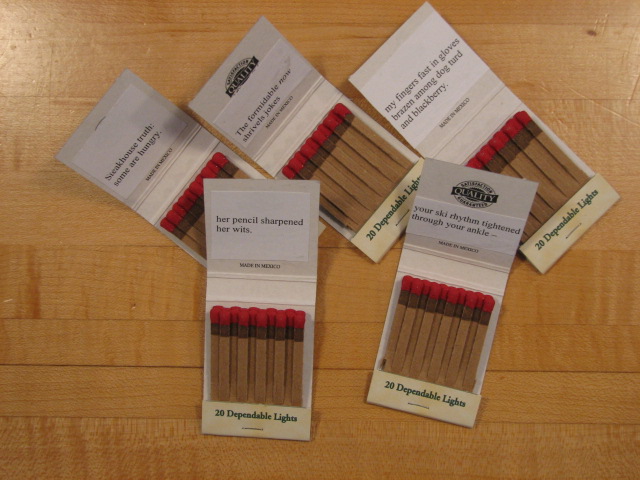
I sent off five poetry bits to A.K. Allin/Matchbook Poems/403 Roy St. #26/Seattle, WA 98109. Today, Tuesday, August 15, 2006 is the deadline day, though the email I got Sunday said send an email if you want to send and can't by the 15th. Since I know there are dozens of you reading this and not commenting because you're shy, I'll put the email address here: mimiallin@gmail.com so you can email right away. I sent some of the ones I wrote about and took portraits of, but made a couple of changes, since, having written about not being able to be thoughtful, I was a little bit more able to apply my brain in making decisions about what to send. I ditched: "Steakhouse truth:/some are hungry." Now I think that was dumb.
(with apologies to Bill Stafford)
In my ordinary life as writer, time is not a critical factor. Let's say I need a synonym for the word "forgetful" - at my leisure I can search my own cranial vaults, the various thesauri on my shelves, the hilariously off-base thesaurus in Word, and muse of whichever ones of these seem suitable. Time! Hah! It does not exist for me. I am out of time, beyond time, mini immortal in my lack of dependence on its constraints.